« My father’s secret gardens » by Samia ElEchi
The garden has always been, across many cultures, a symbol of Paradise, of the Cosmos whose center it occupies. As a figure of a celestial world, it exists at the boundary between the visible and the sensible, between mystery and infinity. It is both a space of retreat and of revelation, set apart yet crossing into elsewhere, where imagination takes root and awakens.
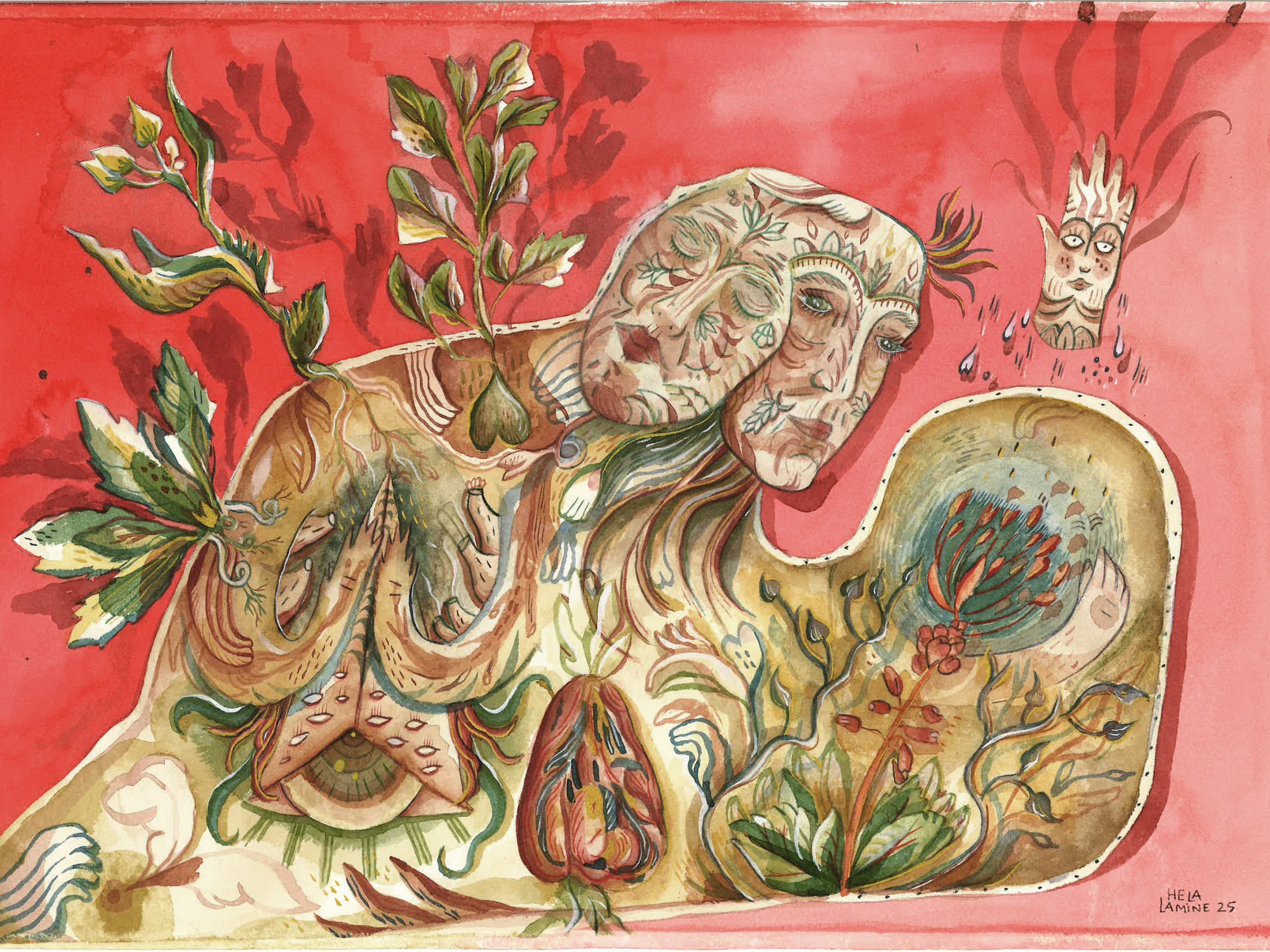
In her father’s “secret” gardens, Hela Lamine seems to reconstruct the memories of this lost paradise. She invites us to cross its threshold, to rebuild images of her inner world like plants that are both fragile and resilient. As she described the secrets of her garden, I could imagine myself within it, my feet rooted in soil nourished by memories and quiet gestures. Her garden embodies the moment when nature becomes a mirror of the soul, a refuge where anyone can plant themselves and cultivate an inner world, balanced between reality and imagination. She offers a place of meaning, not merely to observe, but to traverse — a territory of interiority where each gesture opens a fissure to a utopian world that reorders reality to allow one’s own dreams to grow. Her secret garden sits at the threshold between intimacy and the communal; a suspended garden, center of the inner world, and open doorway to elsewhere, reminiscent of Babylonian gardens with fountains of immortality — the immortality of memory, of a family lineage rooted in the layers of the soul.
Like Montaigne, who would retreat to his small garden to cultivate thought and unite reflections between order and infinity, nature and culture, her father — a biologist — would spend hours in his garden. Silently and attentively, he followed the smallest gestures of nature, observing the traces of a Genesis process, never halted, always in perpetual transformation. From this familial and scientific atmosphere, the artist draws inspiration, where nature takes the form of thought and yields a state of being: an ultimate symbiosis between humans and the vegetal realm. Nature thus remains, for her, another way of inhabiting the world, revealed slowly through the details of her drawings. She unveils an interiority where the act of cultivation merges with creation, where each plant, each root embodies a subtle voice. Her secret garden has become a symbolic space where seeds buried in the depths of memory and gesture germinate.
Hela Lamine roots herself in this family memory, her father as a metaphor for the earth and silent proliferation. Her works become both memory and metamorphosis of the land and the body. Like her father, she tends to her plants, redraws boundaries, adjusts colors, nurtures light, and shapes matter composed of organic fragments, cultivating a soil that links creative gesture with genealogy. She transmits a life cycle, one of interiority offered to contemplation, a journey from intimacy to the wider world. Each drawing becomes an exercise in introspection, letting imagination roam and cultivate a land of dreams. By imagining this secret garden, Hela Lamine reconstructs her being in a quest to “reinhabit herself” through what Gaston Bachelard calls the reverie of nature.
The creative process emerges from a sensitive filial gesture between bodily memory and that of the earth. The garden acquires a corporeal dimension where bodies germinate in the drawings. Self-portraits and portraits of family members intertwine with elements of nature, merging with textures — foliage, roots, flowers, and sky — in a sort of vegetal genealogy, a metaphor for connection and loss. This reveals a desire to root these beings in the same soil, that of a paradise dreamed by the artist. The father stands at the center of this constellation, of this imaginary garden. As in Indigenous American civilizations, the artist conceives her secret garden as a microcosm of the universe, simultaneously near and distant. It is a realm where the boundary between human and vegetal fades, giving way to a poetics of renewal and continuity.
Ultimately, these gardens appear as spaces of reconciliation, where each person can rediscover fragments of what was and finally grow their own dreams. They represent a reverie of the world, transporting us beyond the world into the temporality of stratified memory, where the past nourishes the present. In her works, temporalities condense, allowing movement between life and death, transforming endings into new beginnings.
Samia El Echi 2025
 Hela Lamine