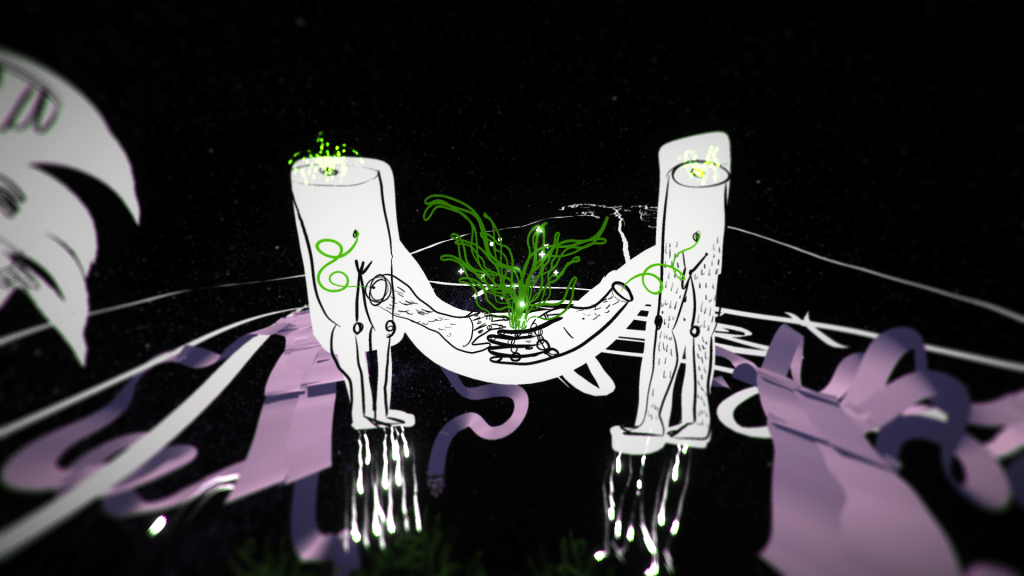
Un personnage féminin a développé ce qu’on appelle un état de stress écologique poussé. Chaque geste du quotidien — sa manière de consommer, de se déplacer, d’exister — est devenu une angoisse. La seule solution qu’elle trouve pour continuer à vivre : se transformer en arbre. Elle va dans la forêt, marche longtemps, s’allonge. Elle n’a aucune idée de comment ça marche. Elle ferme les yeux et commence à respirer, écouter, sentir de l’intérieur la transformation se faire en elle. Still Life traite de cette transformation — l’adaptation comme seul moyen de subsister.
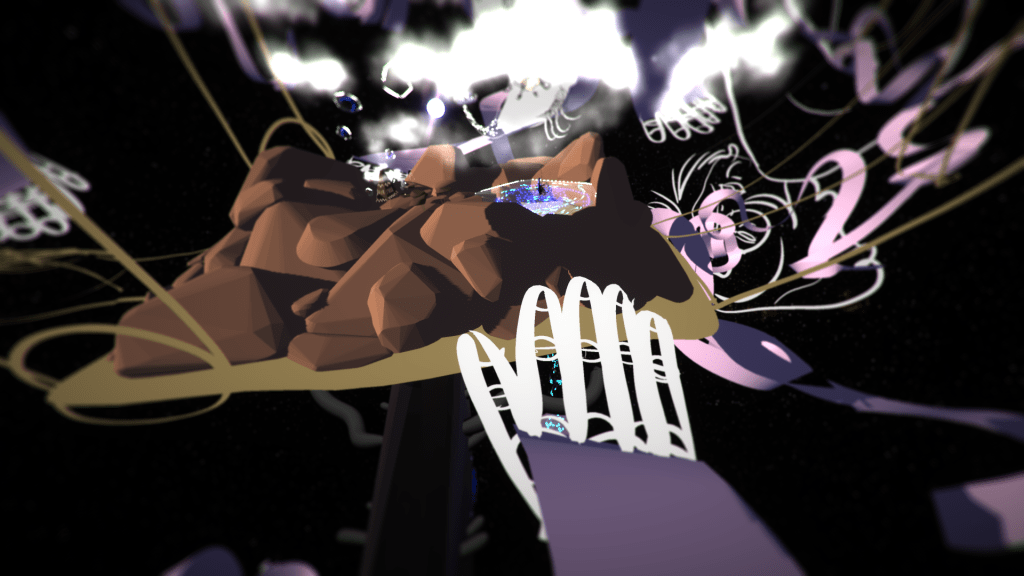
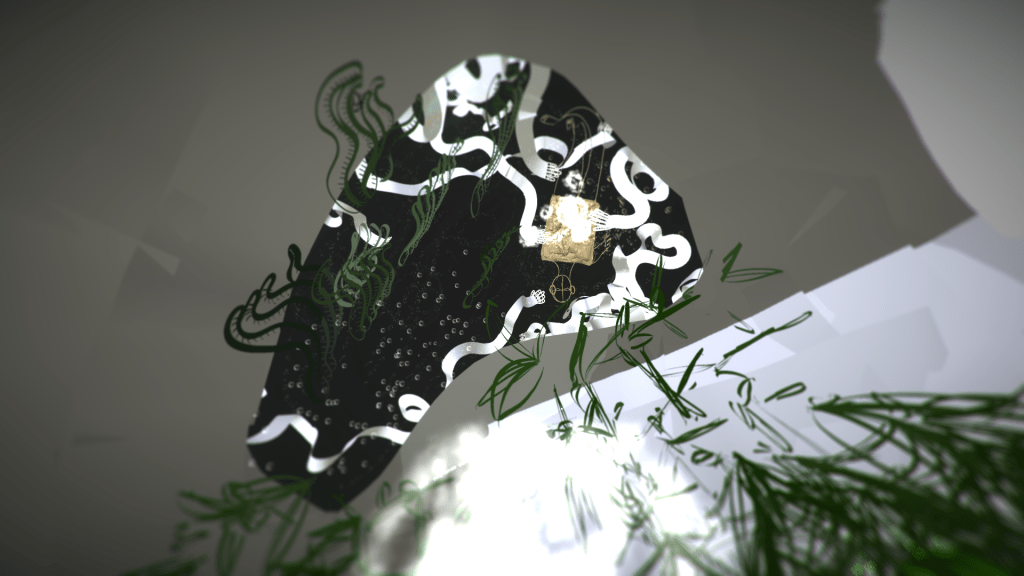
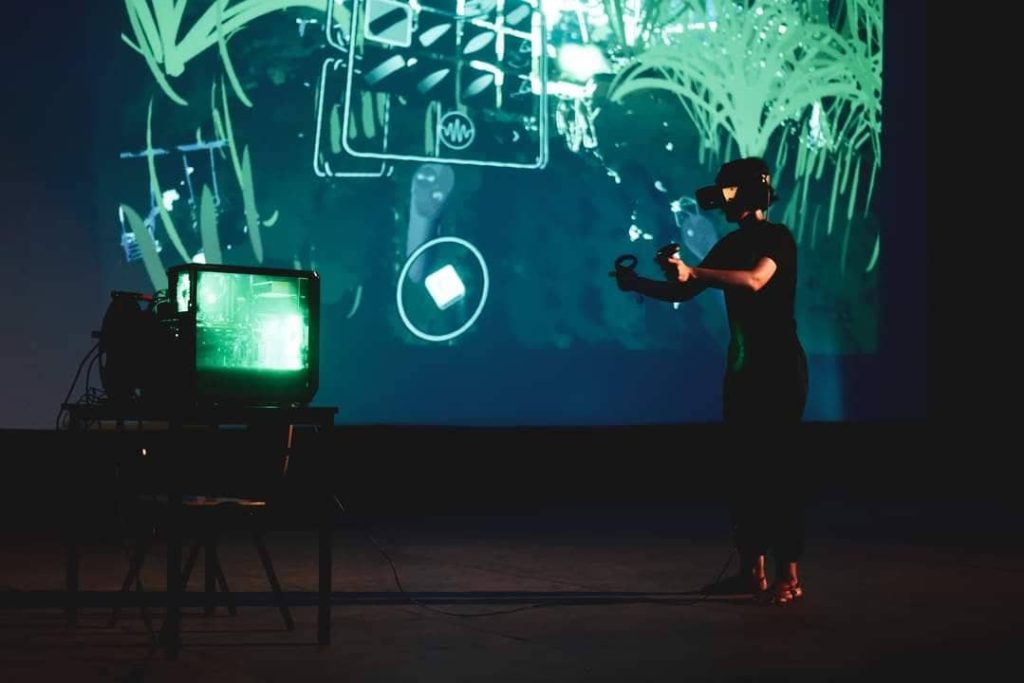
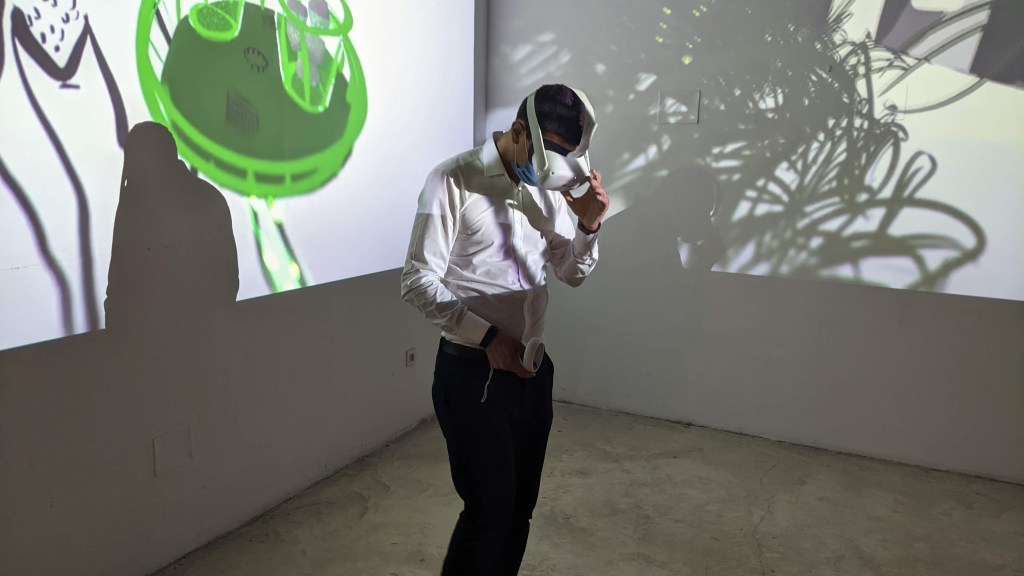
L’expérience est dessinée ligne à ligne dans un casque de réalité virtuelle — non pas sur ordinateur, mais dans l’espace. Sur scène, devant le public, un pinceau de lumière à la main : c’est tout le corps qui dessine. À l’intérieur, une biosphère : plusieurs écosystèmes superposés, peuplés de personnages, figures, animaux, êtres hybrides de toutes tailles. Un dense réseau de dépendances — certains s’imbriquent comme un hôte qui héberge un parasite, partenaire nécessaire à son cycle de vie. On y voit des rituels chamaniques, un déjeuner entre Manet et Lars von Trier, une transfusion sanguine entre un cerf et une fleur. Je me surprends à écouter des pensées qui me semblent étrangères, et à avoir de l’empathie pour une fourmi coincée sous un rocher de l’autre bout de la forêt. La déambulation traverse plusieurs niveaux pour arriver finalement à une zaouïa — un espace de retraite soufie — où se célèbre la cérémonie de transformation.
STILL LIFE 1.0 – Virtual Reality Painting with public Performance – « La nuit des idées, » French Institute of Tunis, 2020STILL LIFE 2.0 – Virtual Reality Painting with public Performance – « Gabes Cinéma Fen » festival, Gabes, 2021
Still Life a changé mon rapport au dessin. Après 2020, je n’arrivais plus à dessiner en 2D — je voyais les choses en 3D, comme à l’intérieur du casque. Pendant tout le processus de création, je n’ai cessé de faire des va-et-vient entre le réel et le virtuel : des dessins que je faisais dans le réel, je les faisais entrer dans le virtuel, et inversement. La première version était très intuitive. Durant le confinement, j’ai cherché à comprendre ce que j’avais dessiné et pourquoi. J’ai fait des recherches sur la communication des arbres, sur les fourmis, sur le cosmos, sur la physique quantique — sur l’infiniment petit directement lié à l’infiniment grand. Cette question d’échelle, on la retrouve partout dans Still Life.
De là sont nés, un à un, tous les projets sur le vivant qui ont suivi : Quand les arbres murmurent (2020) — des boîtes en plexiglas reconstituant en papier découpé ce qui avait été dessiné dans l’espace. Cahier d’automne ou lettre d’amour à un arbre (2021) — des doubles feuilles superposées en 3 à 6 couches pour suggérer le mouvement lent, le temps. Color Wheel (2021) — 7 aquarelles, une par chakra. Dans ma tête pousse une forêt (2023). Et les Jardins de mon père (2025) — où j’ai retrouvé Still Life déjà planté. L’univers est toujours en expansion. Still Life reste un projet ouvert. Une application est en cours de production. « Still Life invites you to immerse yourself in an imagined world and build empathy. You truly get to look at this beautifully curated world from all angles and take on new perspectives. » — Louisa Mammeri, Network Organizer for North Africa and West Asia
Formats Performance de dessin VR en direct avec public — environ 20 minutes, accompagnée d’une création sonore. Vues 360° visionnables au casque. Vidéos projetables en mapping. Aquarelles et maquettes en papier. Diffusion 104 Paris — Gabès Cinéma Fen — Institut Français de Tunisie, Tunis. 2020–2022. Production Intage Production.
Traversée in three ACT
2018-2019
Participatory performances
Between south and north of the mediterranean
The starting point was the national drama that shook Tunisia at the beginning of the summer of 2018 twenty eighteen: (image) The sinking of the makeshift boat that carried two hundred people in the night of june second twenty eighteen , out of Kerkennah (Sfax) to reach Italy, (image carte) and which led in the end, to the death and the disappearance of more than a hundred people, including infants, children and adolescents, of various nationalities. (image)
Various interviews with the survivors were recorded and massively disseminated in the media, narrating in great detail this journey that is unfortunately becoming more and more frequent.
The « Crossing » project draws deeply on one of these interviews in particular: a very touching interview I heard on one of the local radios, where one survivor, clearly still in shock from what he had just experienced, who after giving all the details of this aborted crossing, ends his story by saying « I died at sea… I died with them… and today I am reborn again, today I have a day, today I am a newborn… ».
The project « Traversée » questions the notions of migration and immigration, documented and undocumented. « El harga » (the burning: clandestine migration) and the « Harrag » (the burner: migrant), « those who burn » both their papers, and the borders, who do not hesitate to risk their lives to cross the Mediterranean. A crossing, a group movement during which the place and the role of the individual, embarked in this flow, are put to the test of doubt, improvisation and survival.
It was very important that the project « Traversée », physically implies the body of the other (that of the public), to have it embark in a crossing, which would take by its form of ritual, or festive and convivial ceremony to celebrate together a rebirth.From its inception Traversée was thought and designed as two folds, with two different forms and temporalities : “The Ch9af el 7orriga” hybrid mural // and the participatory immersive performance « Blue Iftar » (Tunis) and « Crossing » (Perugia)
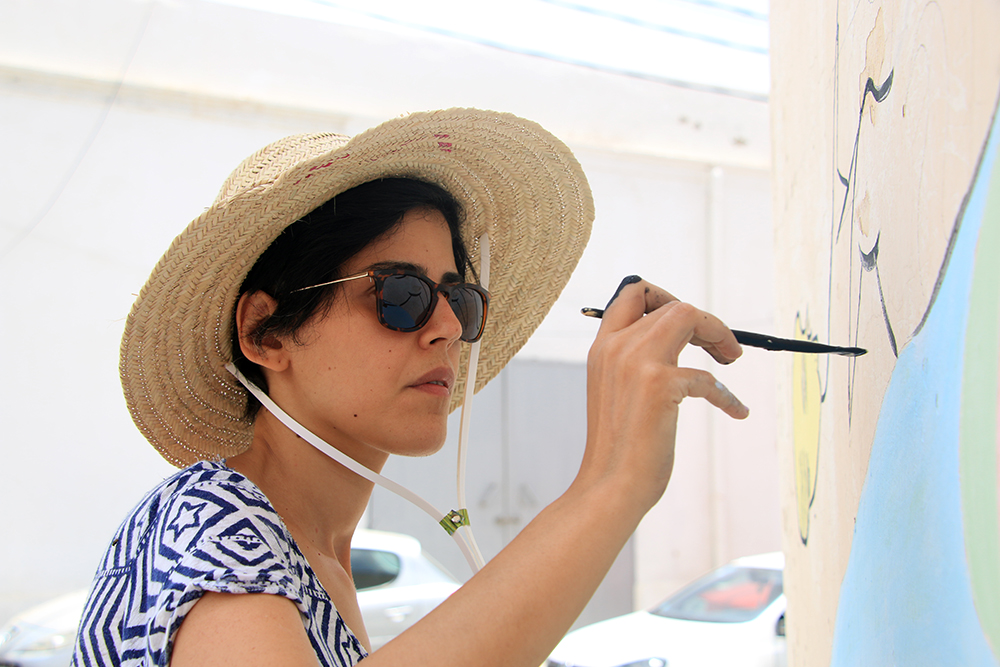
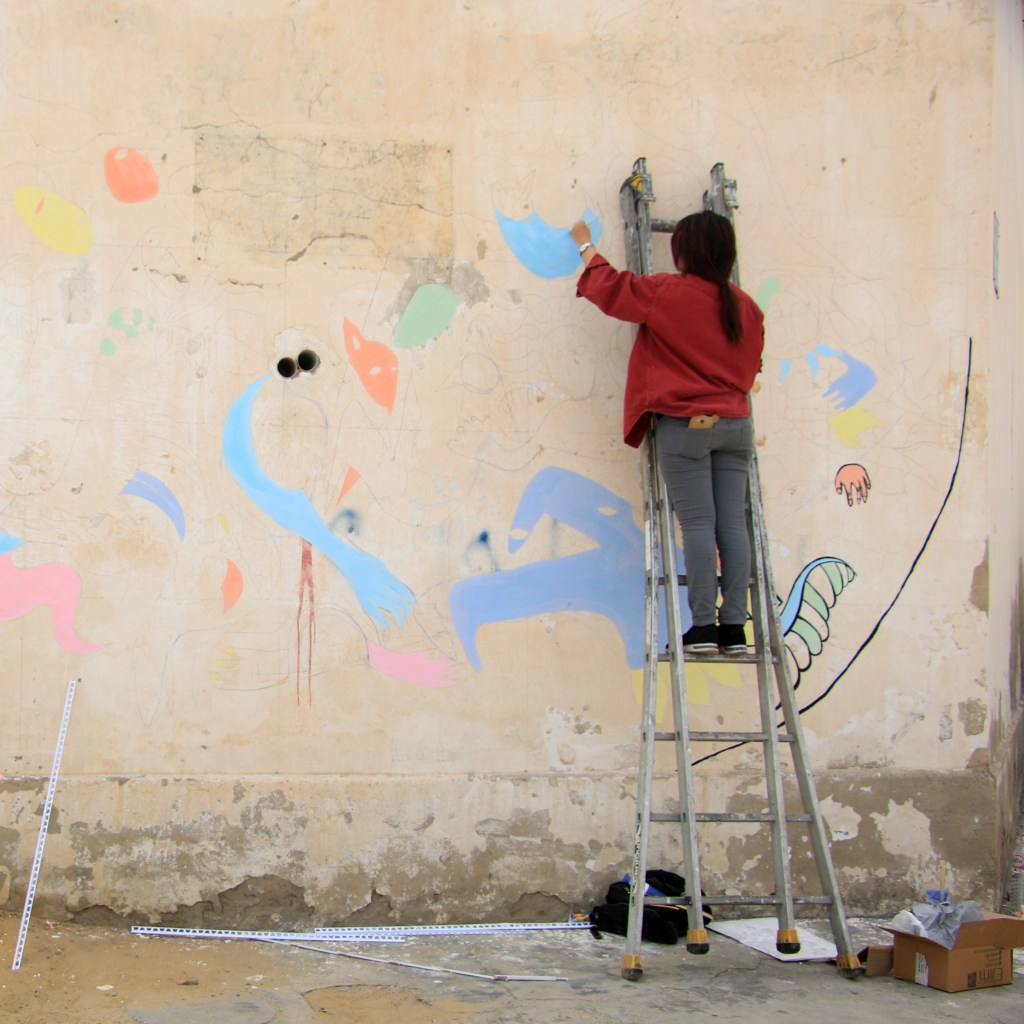
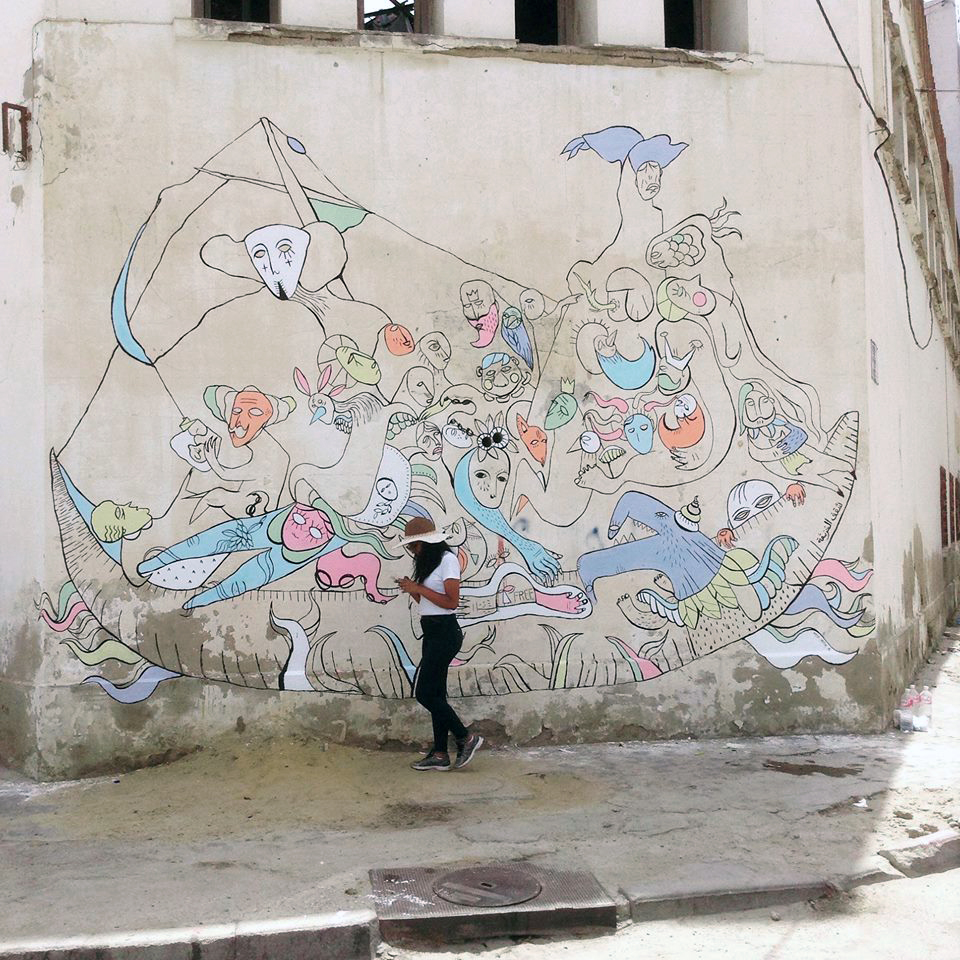
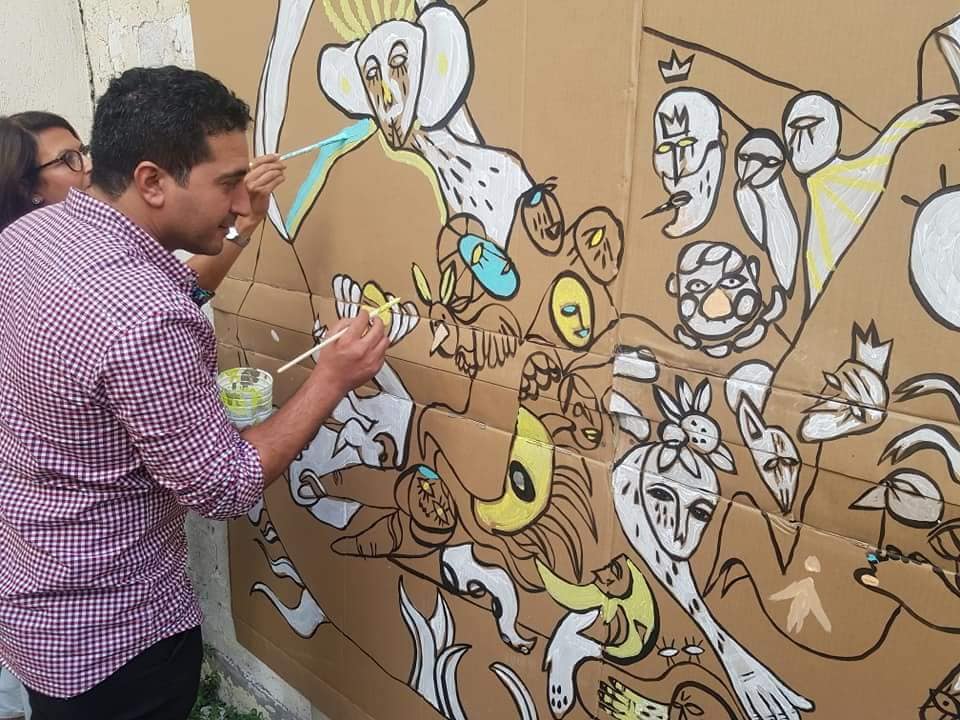
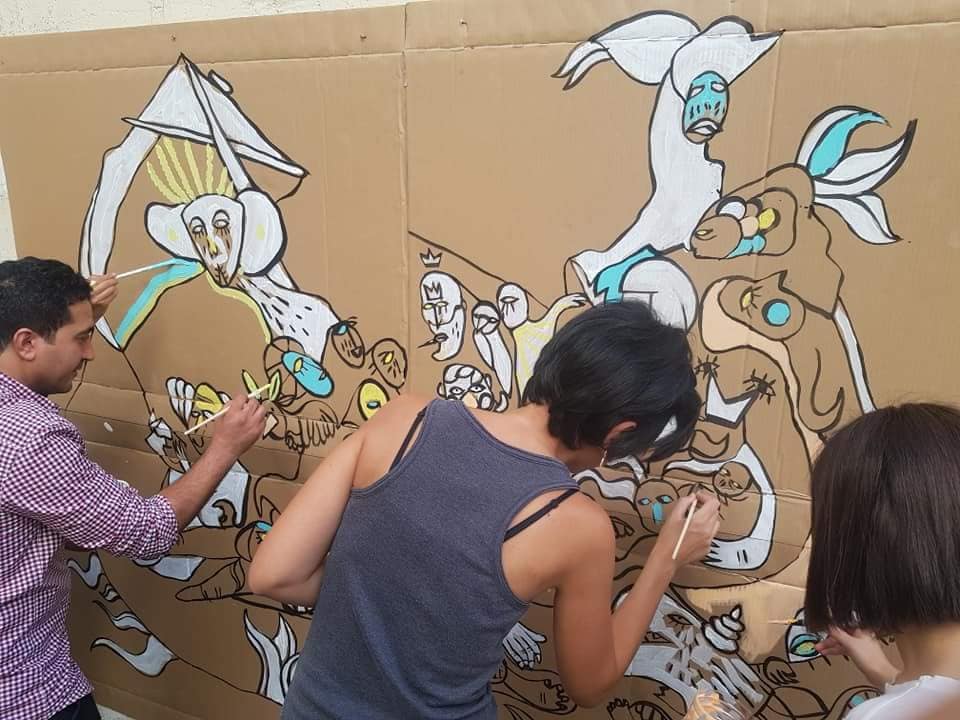
fresco « ch9af El 7orrigua » (boat of the jellyfish) which is a fresco made on July third of twenty eighteen in Sousse, during the artist residency “Utopies visuelles” « Visual Utopias » organized by the gallery Elbirou.
I had imagined a dialogue of the deaf between two works « The raft of the Medusa » of Géricault found in the Louvre in Paris (France) and the mosaic of Medusa found in the archaeological museum of Sousse (Tunisia).
The « boat of the jellyfish » remains visible to the day on one of the walls of the old post office building in « b7ar ezzebla » (sea of garbage) It was important to have this participatory work in a public space, where the ownership of the work is communal. Ultimately the mural belongs to this neighborhood and to the public.
I had painted the design in black line and suggested to my former students to add the color. The idea was that it was the color that would allow the boat to take off.
Ch9af el 7orrigua, Bhar ezzebla, Sousse, 2018.
I imagined then that it could become itinerant. I wasn’t going to move the wall. But I was going to make it travel, in the form of an itinerant and participatory performance across Europe to raise this political issue in a striking visual way that would also have a public participatory component, whenever it was possible to do so.
As a teacher, with a monthly salary, working in the public sector, I was granted a visa to Europe . I could cross the Mediterranean legally, without putting my life in danger. I had to get my passengers from the Medusa boat and they had to reach Europe safely. Finally, Medusa will have the opportunity to meet Géricault and his raft.(it’s essential to note the current political context, where EU countries are making it harder to get visas, even for those, like me, who are not considered undesirable, who do not constitute what Europes consider the danger of “harka”)
At the first opportunity: 3 months later, Medusa’s boat succeeded in crossing the border . This time in a transportable version (on a cardboard box), and loaded with all its passengers. They were warmly welcomed by the inhabitants of the district, who even welcomed one of the travelers at their home.
The Medusa boat continued its journey. It arrived in Switzerland one year later, with one less traveler (he is shown here in black).
A month later it finally arrived in Italy. At this participatory performance, I distributed postcards with the same image to be colored and spread.
« The jellyfish boat » continues its journey, probably somewhere at sea. Perhaps it will soon dock at the American continent.
Ch9af el 7orrigua, IESA, Paris, 2018.Ch9af el 7orrigua, Villa Dutoit, Geneva, 2018.Ch9af el 7orrigua, Tangram, Perugia, 2019.
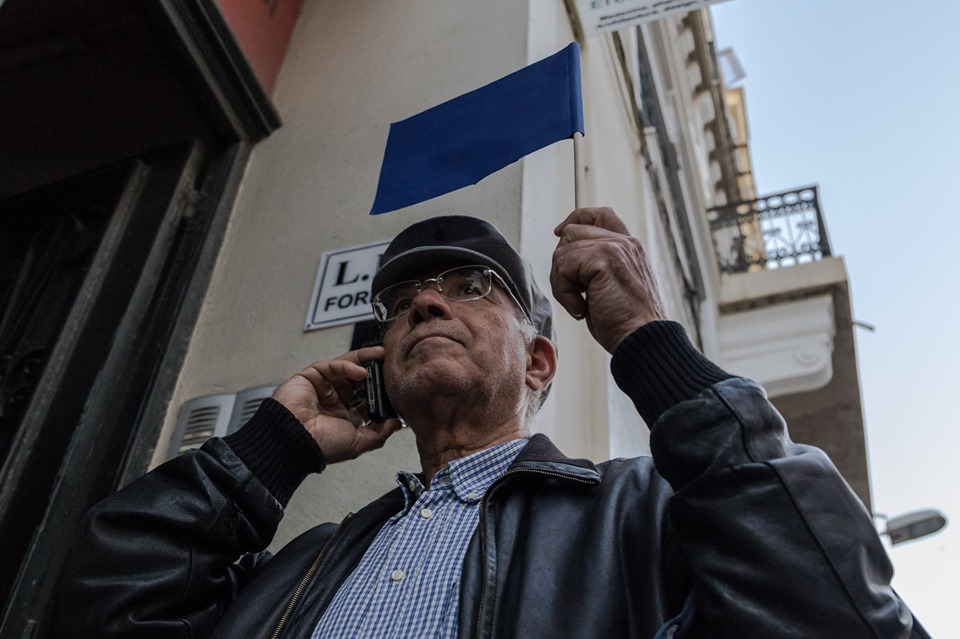
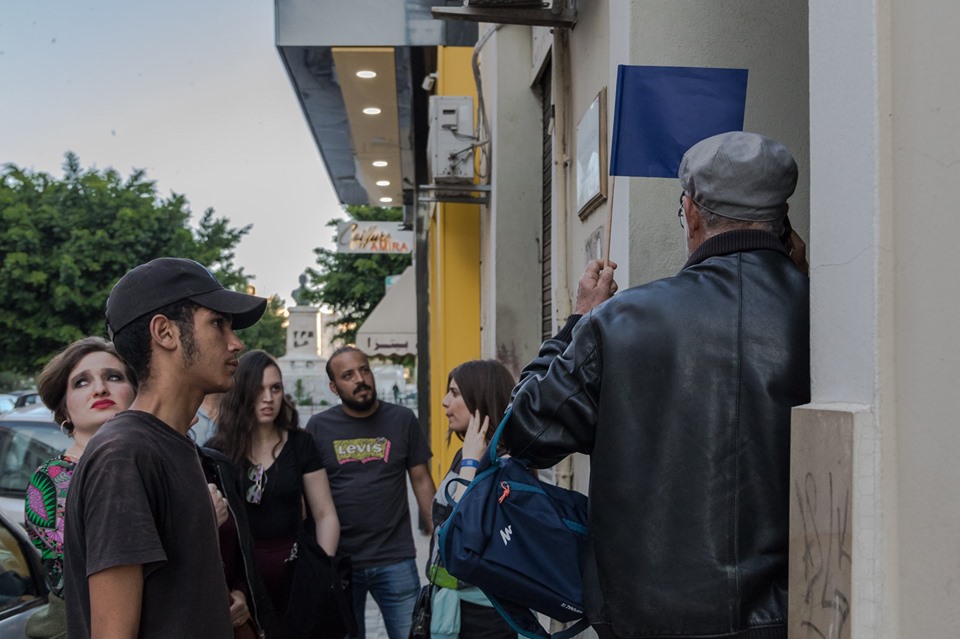
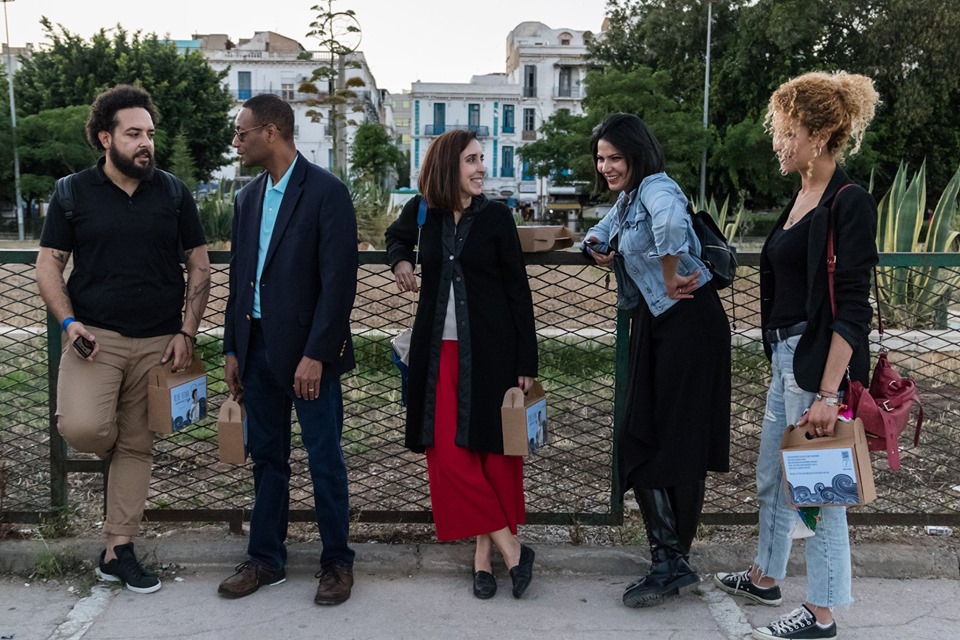
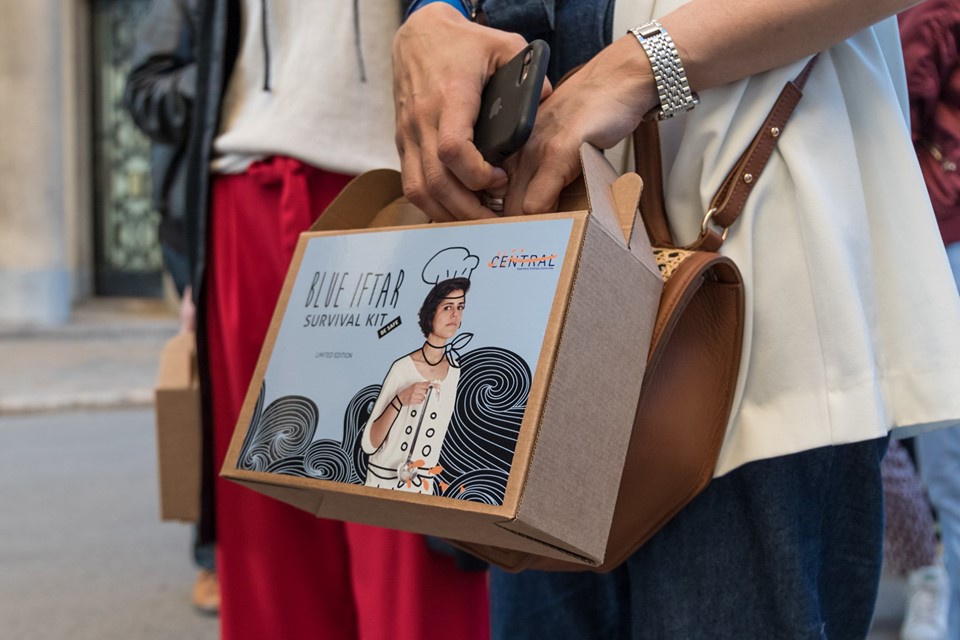
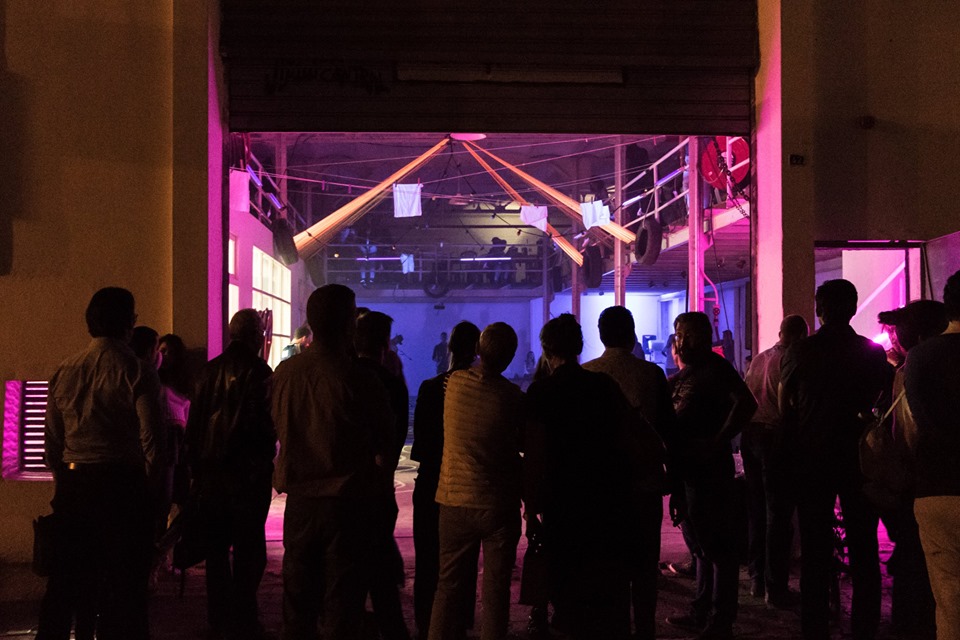
The second part, discussed here, is entitled « Blue Iftar », which i imagined as an immersive and participatory performance. This performance took place on June second twenty nineteen, on the one year anniversary of the sinking of the migrant boat in Kerkennah. We announced, with Central Tunis, the gallery that produced this performance, a surprise iftar (the breaking of fast dinner during Ramadan) with me. People had then paid for a dinner and found themselves part of an unexpected walk through the streets of Tunis that began an hour and a half before the actual Iftar time. Over one hundred people were taken on this mystery walk.
What they didn’t know was that this walk was a detailed account of a migrant’s journey across the Mediterranean to Europe. To materialize this journey, I had noted six points on a map: from the haraka’s home to the « ch9af » (the final boat). I wanted to physically engage the audience’s body, hungry from the ordeal of fasting, in a walk that would cross six places in downtown Tunis. Again, the intention was not to tell the death of the one hundred and forty travelers, but to celebrate the life, the rebirth of the sixty- eight survivors, without removing the emotional and political weight of the situation.
Traversée – ACT III : Crossing
Just like the fresco, this performance traveled across the Mediterranean and was replayed in a different version.
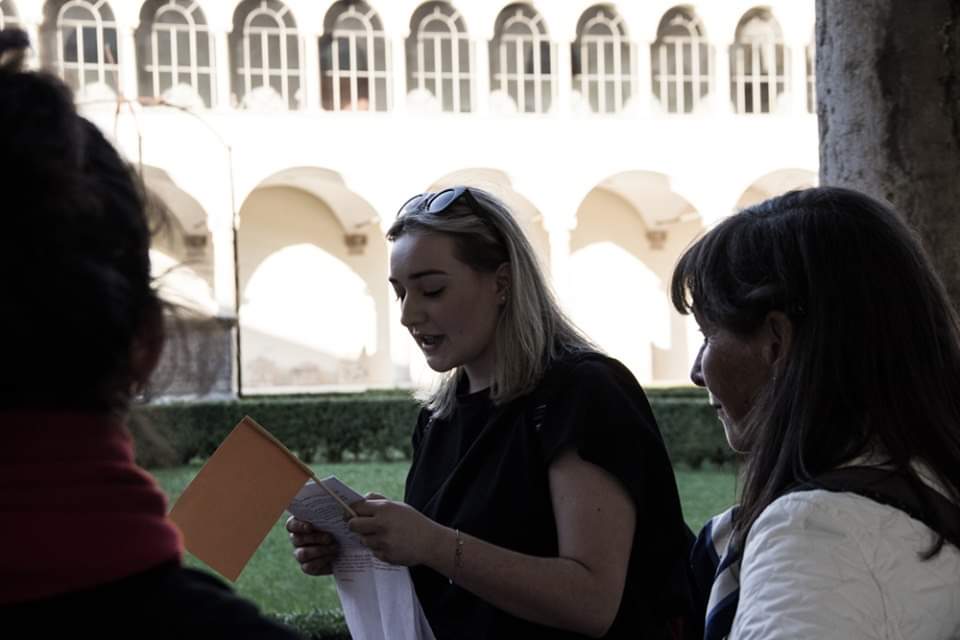
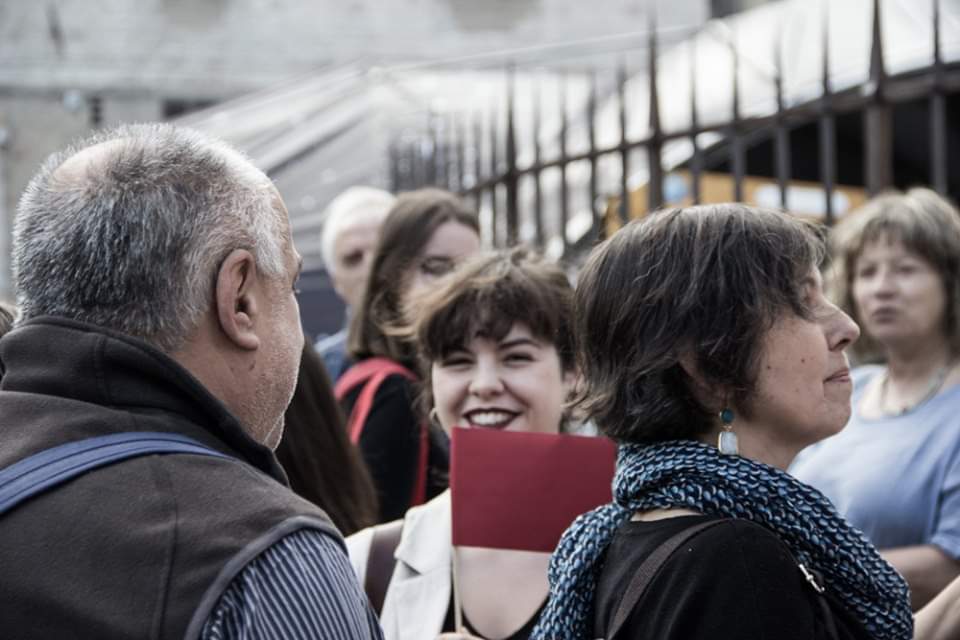
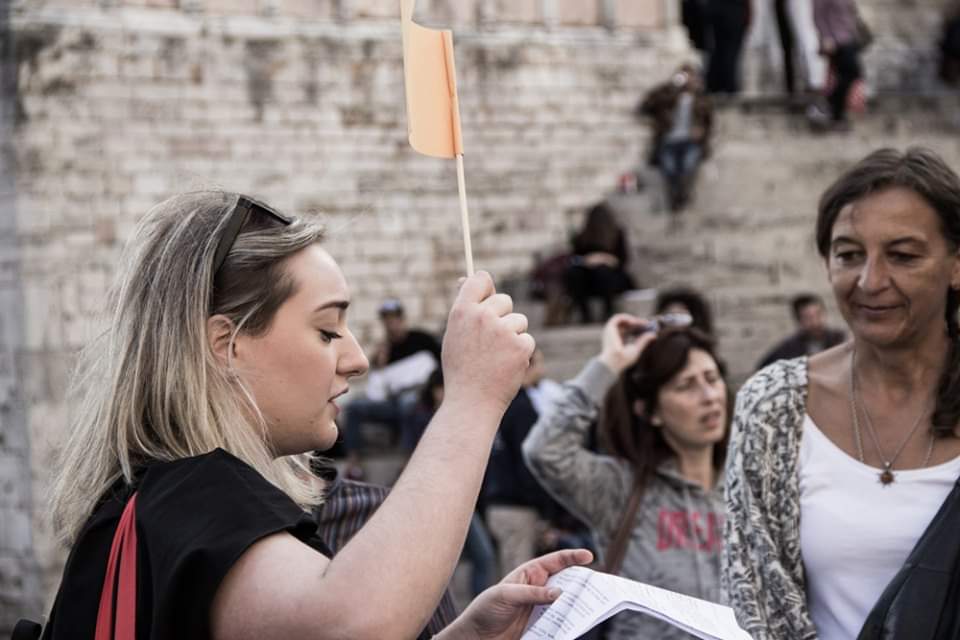
A few months later, I was invited to the « Open Art Week » in Perugia, Italy. I saw an opportunity to reverse the roles, with a lighter version of « Blue Iftar », where the Italian public could become a migrant for a performance.
Crossing
Curated by Gaia Toschi
Open Art Week
12/10/2019 Perugia (Italy)
(c) photo: Valeria Pierini
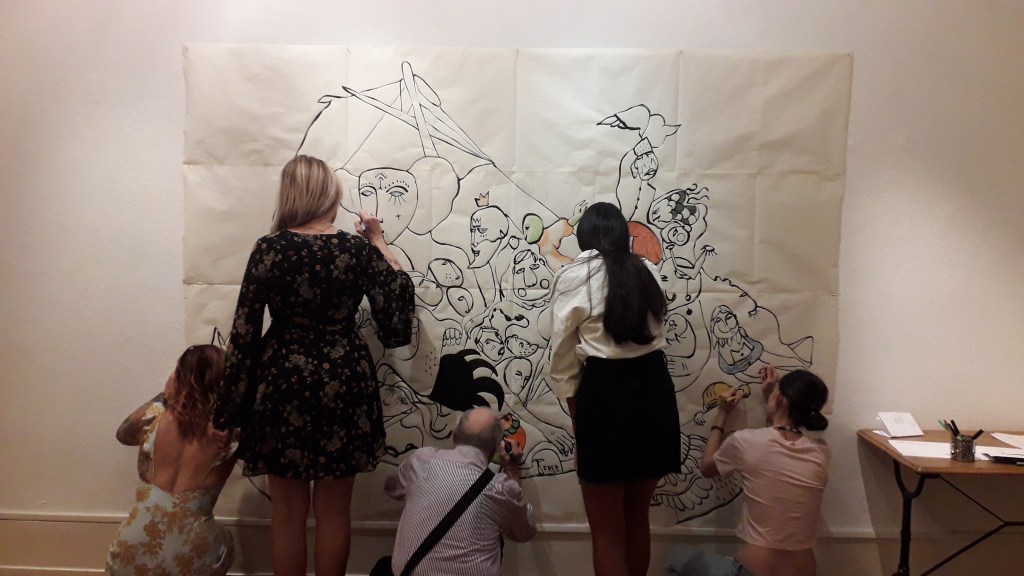
Collective and immersive performance, 120 min, Perugia, 2019.
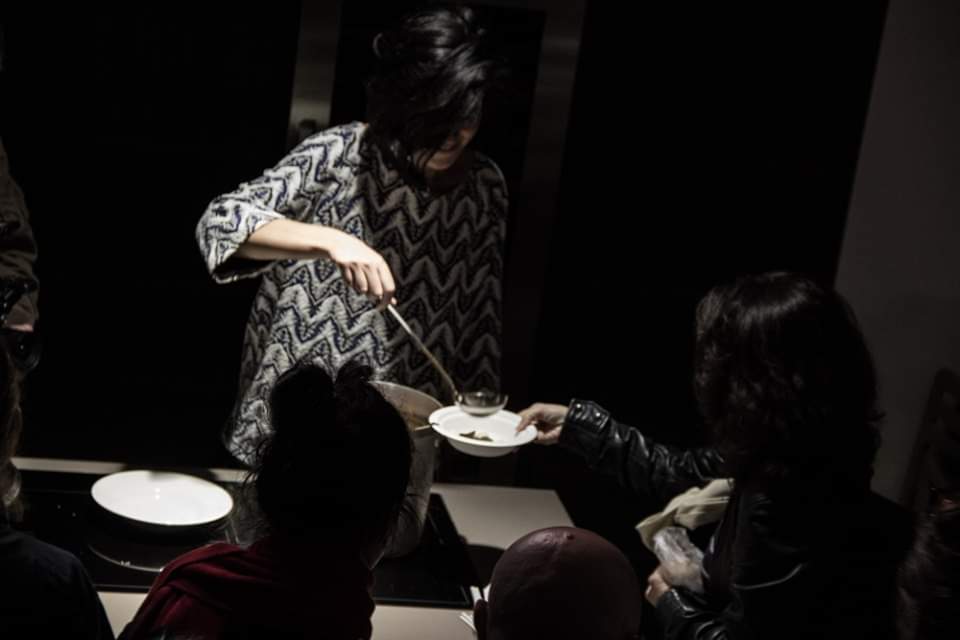
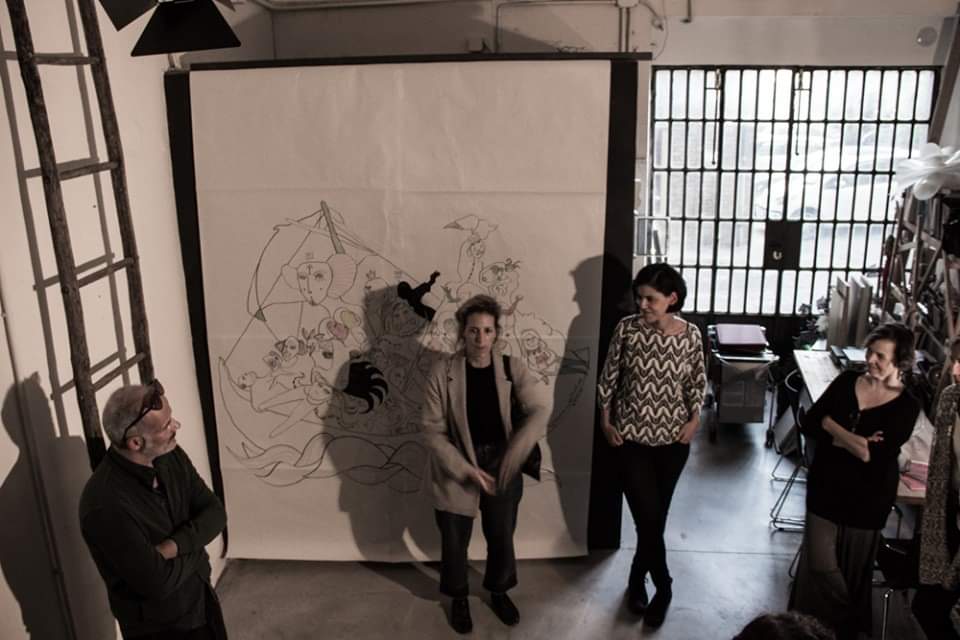
The city of Perugia is a historical city, known for its landmarks. I therefore imagined a fake guided tour of the city that would take the participants through a city walk in six different places. The imagined text was inspired by the real history of each place. To these stories was added the tale of a group of travelers from an ancient time, who dreamed of making a great journey, moving from one point to another. A spiritual journey to conquer a better future … The coveted land was almost a mirage, a land unattainable (a parallel with the Eldorado that is Europe for the Harakkas). The performance ended with an ultimate test to unsettle them, challenge what they feel and experience, as individuals and part of a larger group. They find me in front of a huge cooking pot filled with fish soup, that I invite them to consume in silence, before inviting them to draw the mural together.
Zoom sur quelques mets d'un menu cannibale
Curated by Souad Mani
Novembre numérique
Sousse
GIF, 1"
2018
« 3ijja Bel 9alb » (Omelette au cœur)
3in Sbanoureia » (L’œil d’une espagnole)
Dhbiha
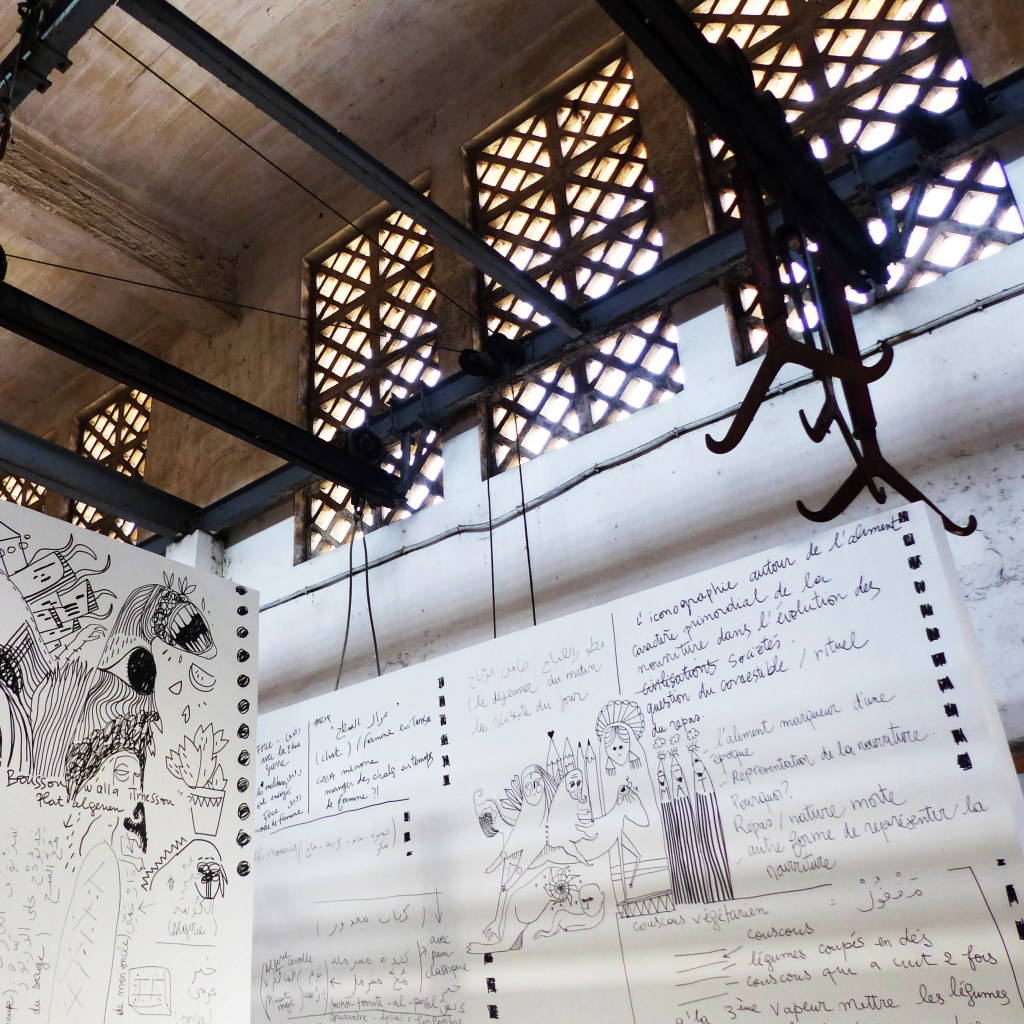
RÉSIDENCE D’ARTISTE ARKANE AFRIKA 2 // EXPOSITION INTERNATIONALE D’ART CONTEMPORAIN D’AFRIQUE À CASABLANCA // ANCIENS ABATTOIRS DE CASABLANCA // MARS-AVRIL 2016.
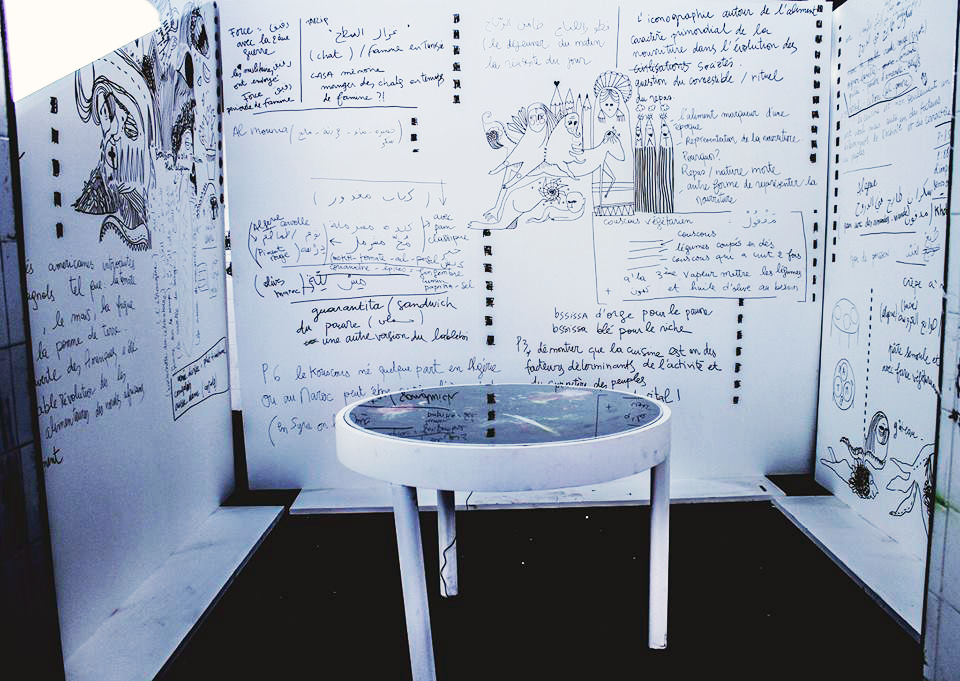
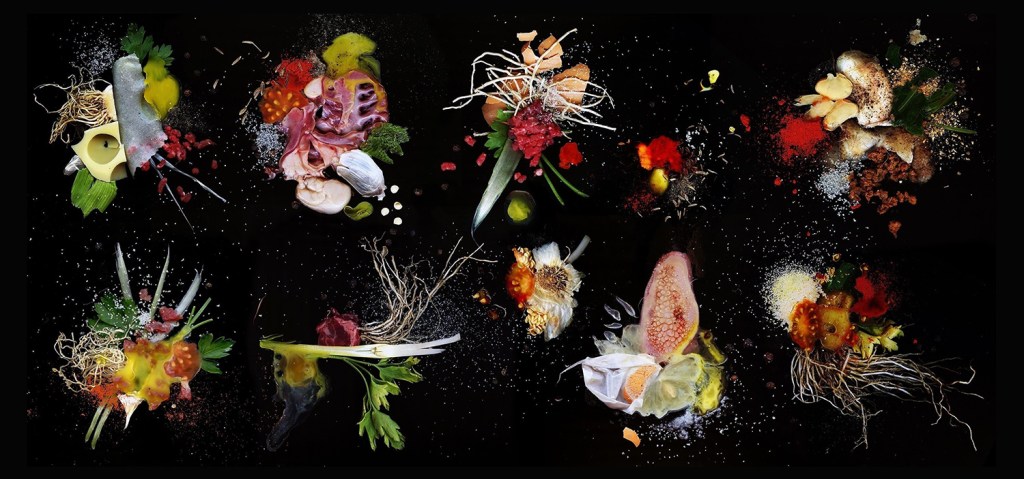
Installation : table lumineuse avec tirage sur papier translucent de scanographie d'aliments,  3 agrandissements de carnet de voyage.
Vue de haut de la table, scanographie imprimée sur papier translucent, 100x100cm, 2016.
Le festin des affamés
Résidence d’artiste « Indice d’une suite »
Galerie Glassbox // Juin 2014 – décembre 2015
Galerie Glassbox – Musée National du Bardo
Curators : Clémence Agnez, Sabrina Issa et Damien Roger
Aide à la production:  Kasbah Nova
«Le festin des affamés», table lumineuse interactive, 160x75x90 cm, 2014. (crédit photo: Raphaële Kriegel) Deux spectateurs sont invités à se placer face à face (au sens de la longueur) et tirer à tour de rôle le câble noir qui se dégage des deux extrémités et font ainsi déplacer une lumière placée sous la scanographie. Un texte est placé à proximité titré «Le festin des affamés» avec le nom de 10 plats tunisiens et leurs traductions littérale en français.Vue de dessus de la table « Le festin des affamés », scanographie tirée sur papier Translucent, 160×75 cm, 2014.
Performances nécrophagiques
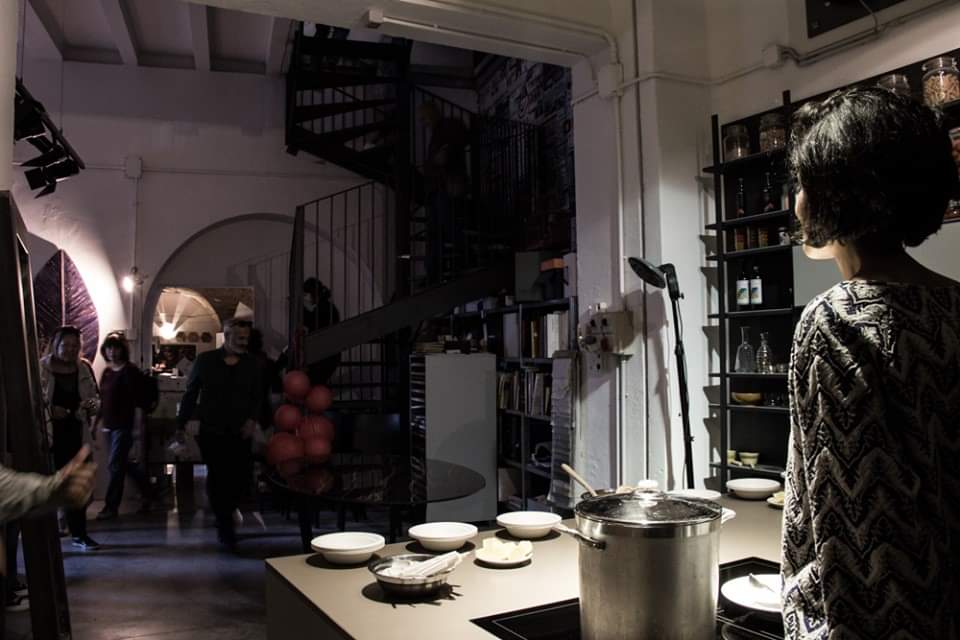
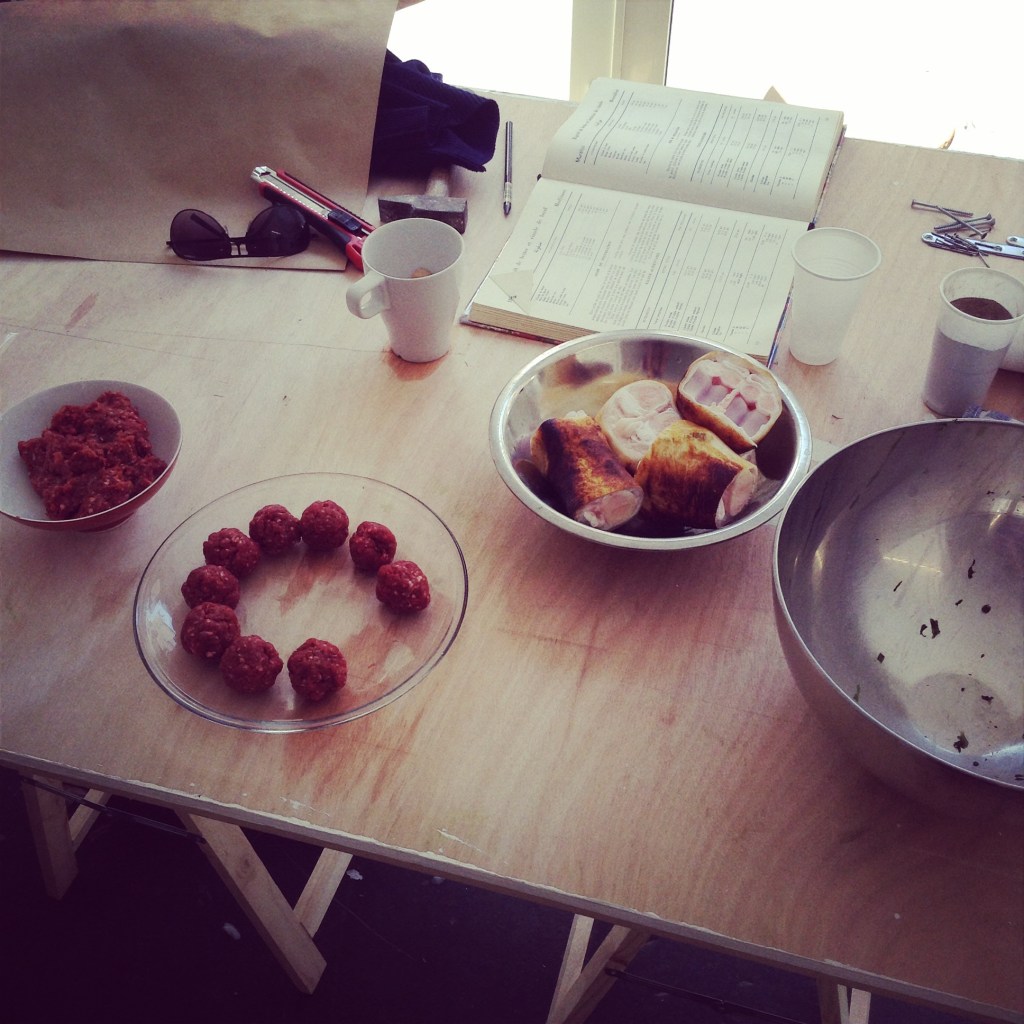
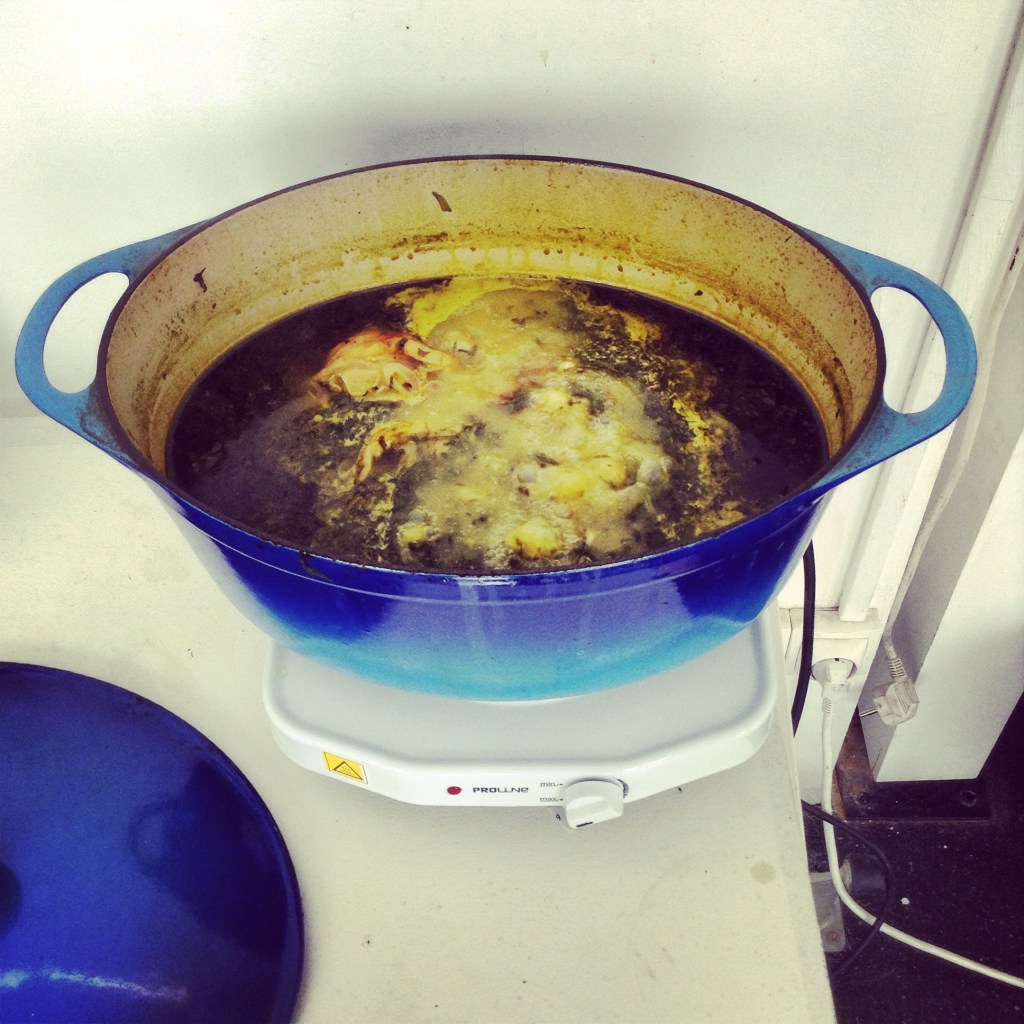
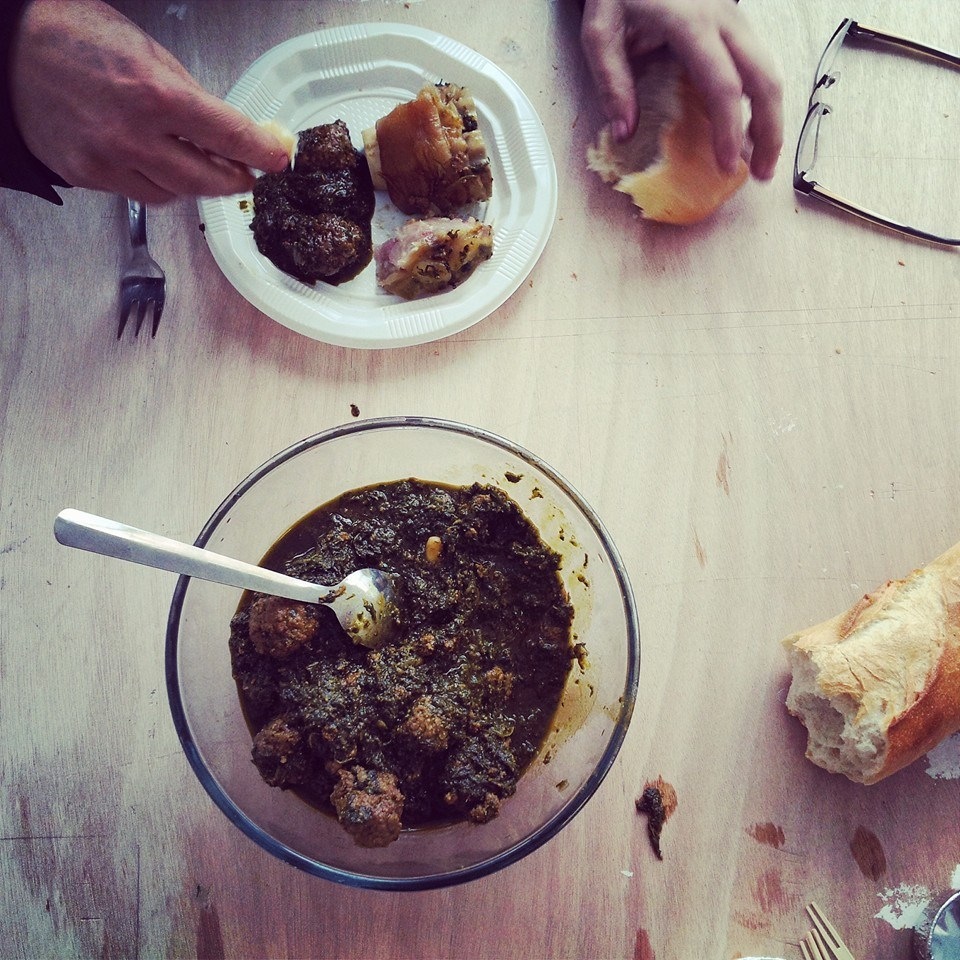
« DÉGU-STATION MADFOUNA » : 1ÈRE PERFORMANCE CULINAIRE “NÉCROPHAGIQUE” : PRÉPARATION ET DÉGUSTATION AVEC LE PUBLIC DU PLAT TRADITIONNEL APPELÉ “MADFOUNA” (TRAD. L’ENTERRÉE). 11 JUIN- 12H/19H – GALERIE GLASSBOX – PARIS.
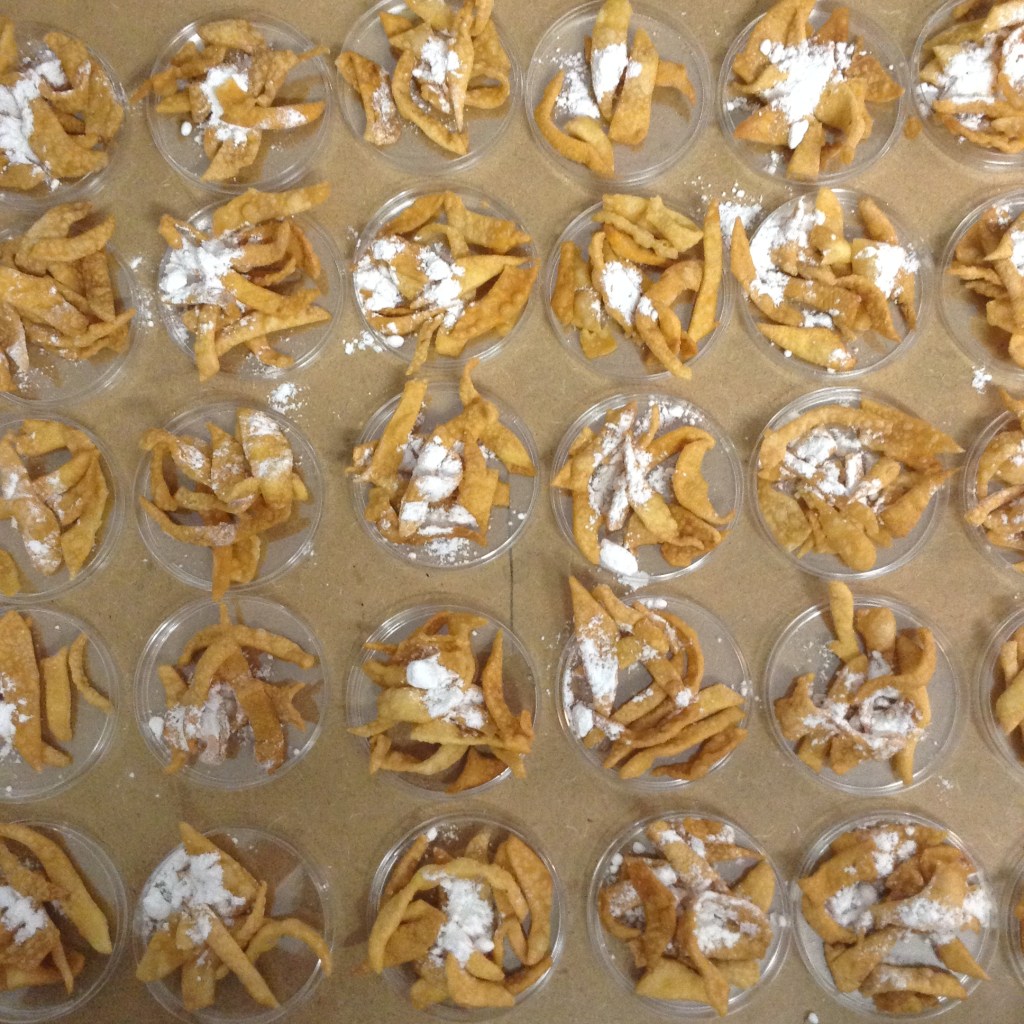
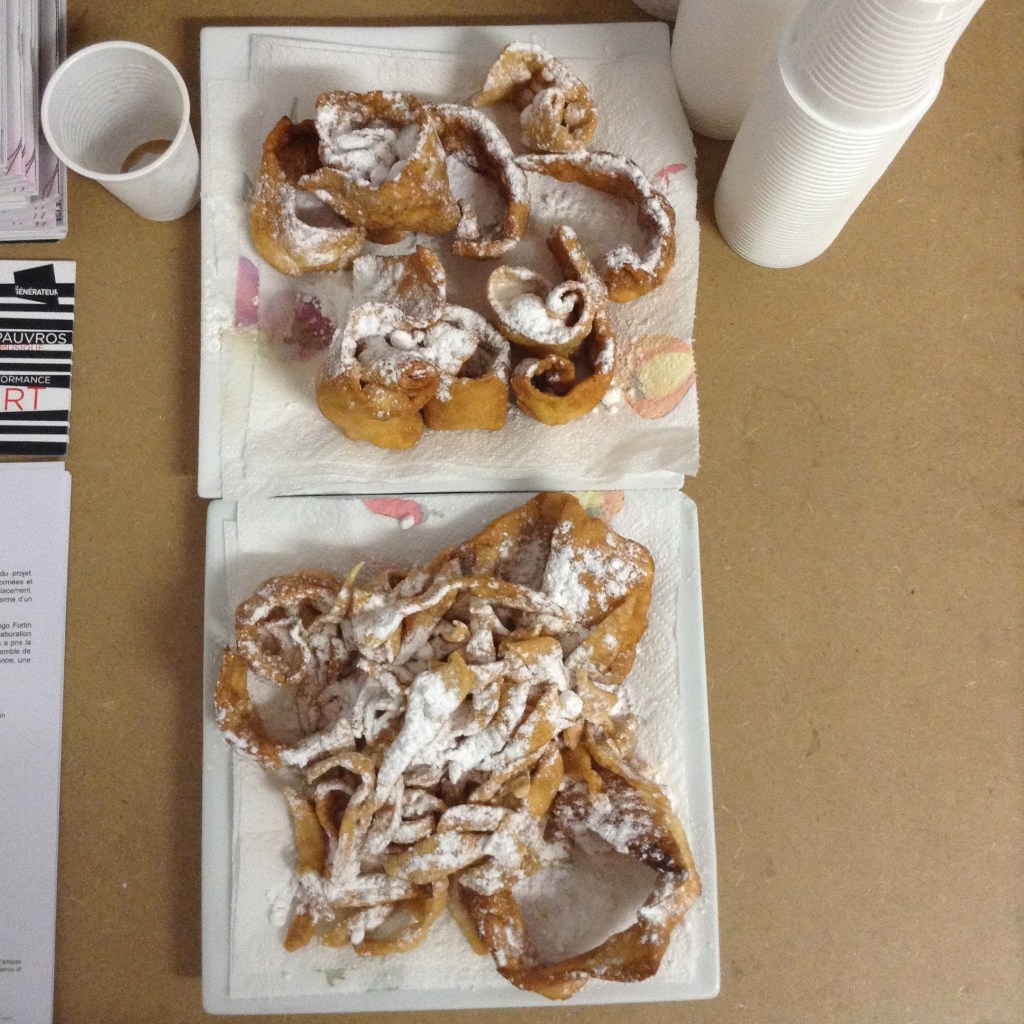
« MANGEONS LES OREILLES DU JUGE! : BUFFET 100% CANNIBALE » : 2ÈME PERFORMANCE CULINAIRE “NÉCROPHAGIQUE”, PRÉPARATION ET DÉGUSTATION AVEC LE PUBLIC DE LA PÂTISSERIE TRADITIONNELLE TUNISIENNE APPELÉE “WIDHNIN EL KADHI” (TRAD. LES OREILLES DU JUGE) (VERSION ÉCLATÉE). 19 JUIN- 19H/21H- GALERIE GLASSBOX – PARIS
1001 mains
1001 mains
In collaboration with Myriam Meliani
Masmoudi Sfax
Pruduced by Masmoudi
(c) photo : Selim Gribaa
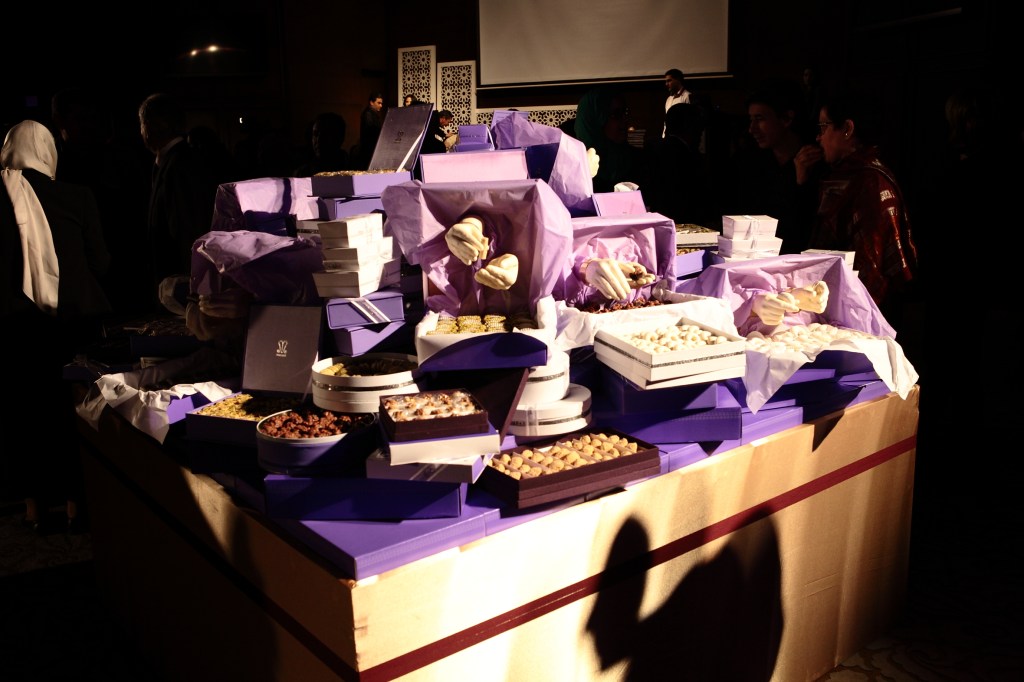
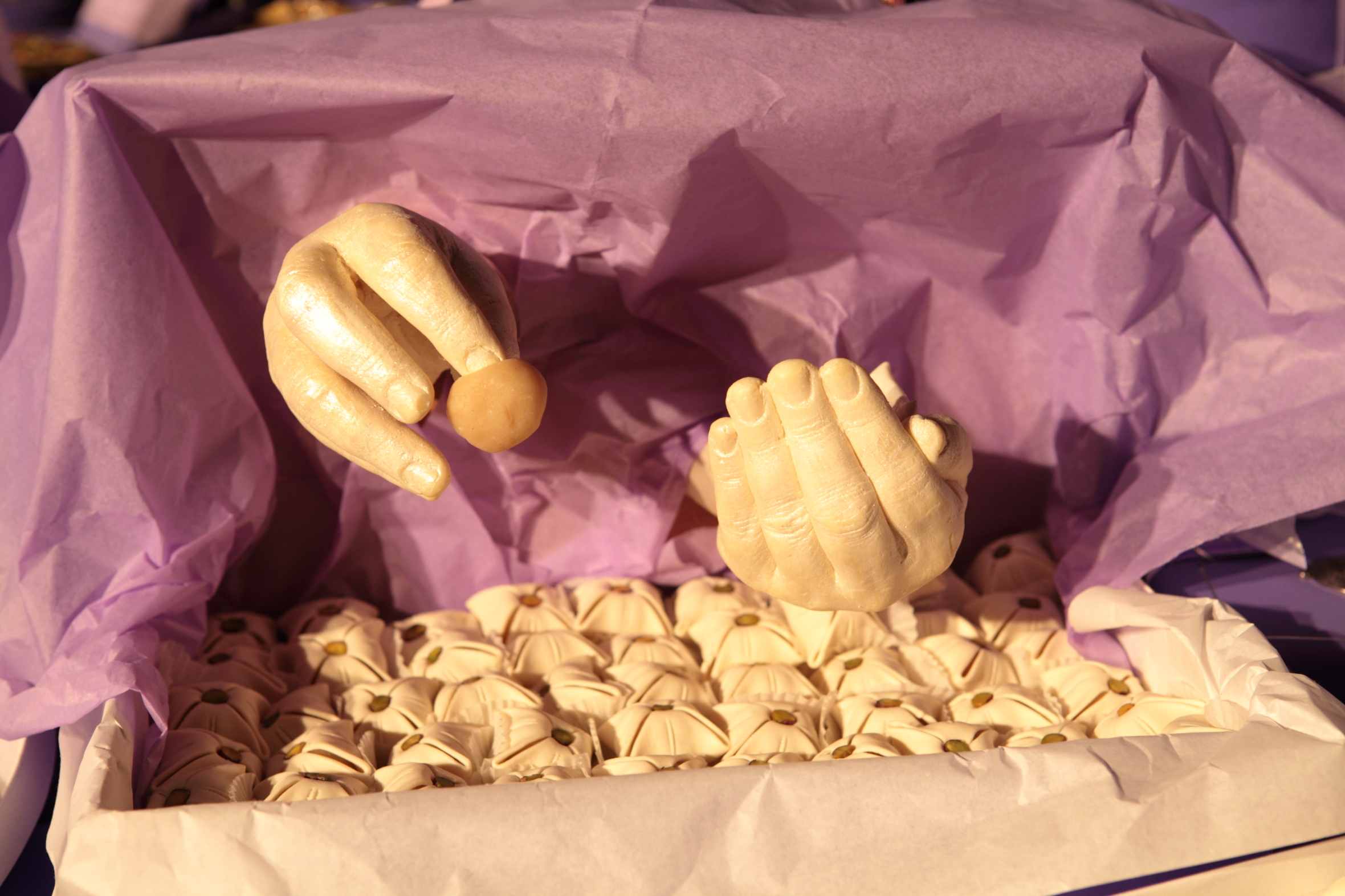
installation comestible, composée de 3 grandes boîtes à gâteaux de 200x200x180 cm chacune, contenant 24 paires de mains en chocolat entrain de fabriquer des petits gâteaux Masmoudi.
2014
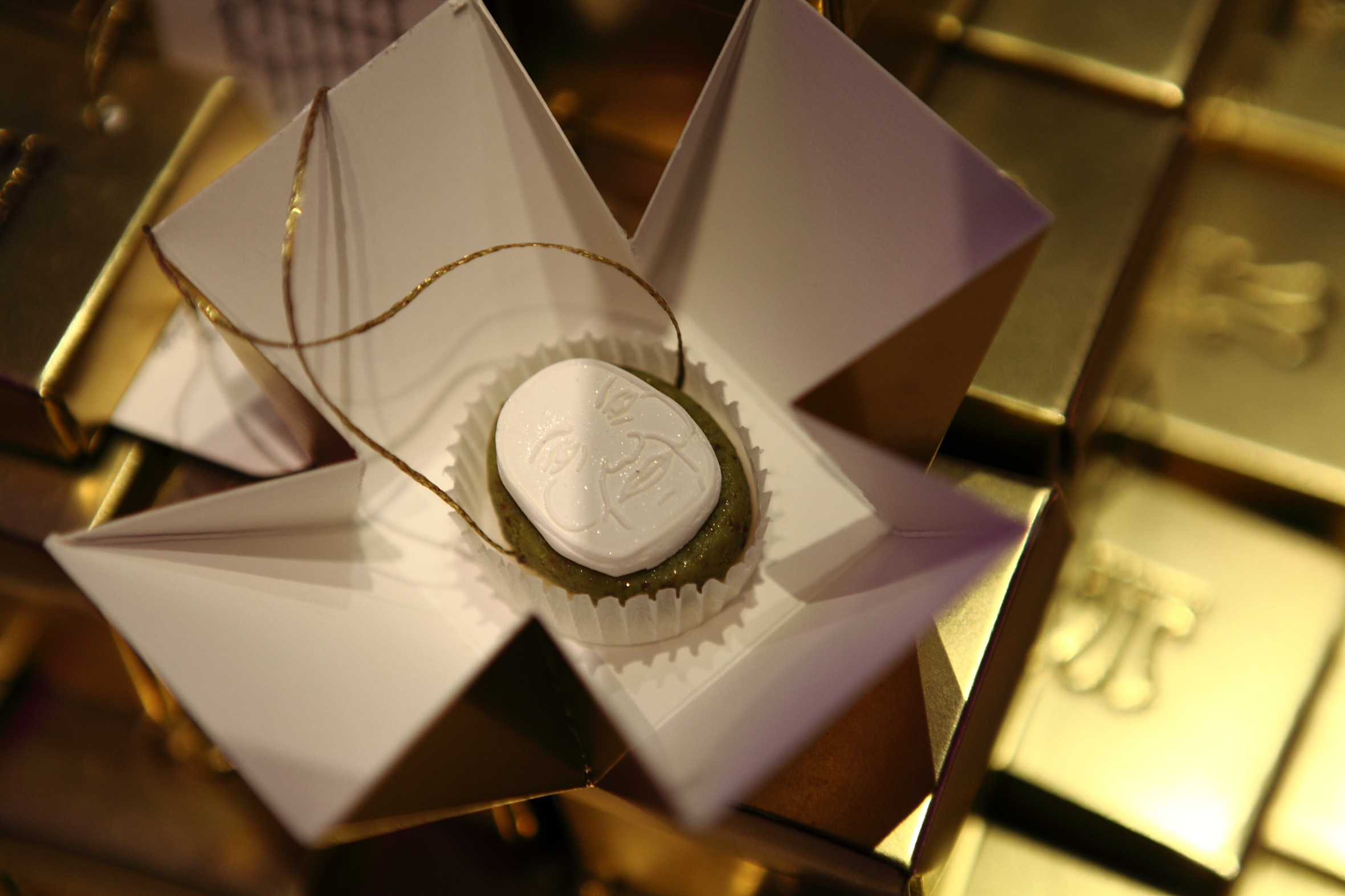
« Le pendentif gourmet – Tête de Mme Masmoudi à croquer », boîte 5x5x5 cm, contenant un collier comestible. Ingrédients: pistache, amande, sucre.









































 Hela Lamine